Share


Birmingham: The UK's Most Overlooked Property Market?
June 25, 2026 | Education

London still gets the headlines. But ask where the rental yields, the regeneration spend and the population growth are actually pointing, and a different city comes up again and again: Birmingham.
The UK's second city has spent the last decade quietly building a property case that's hard to ignore, with lower entry prices, materially higher rental income, and one of the largest regeneration pipelines outside the capital. For international investors weighing up where UK residential exposure actually works hardest, it's worth a proper look.
A yield story London can't tell
Start with the basic arithmetic. Average property prices in London now sit well over double those in Birmingham, while the rent investors receive doesn't scale anywhere near proportionally. The result is a London gross yield that typically falls in the 3–5% range, with management costs and maintenance bringing it closer to 2.5–3.5%.
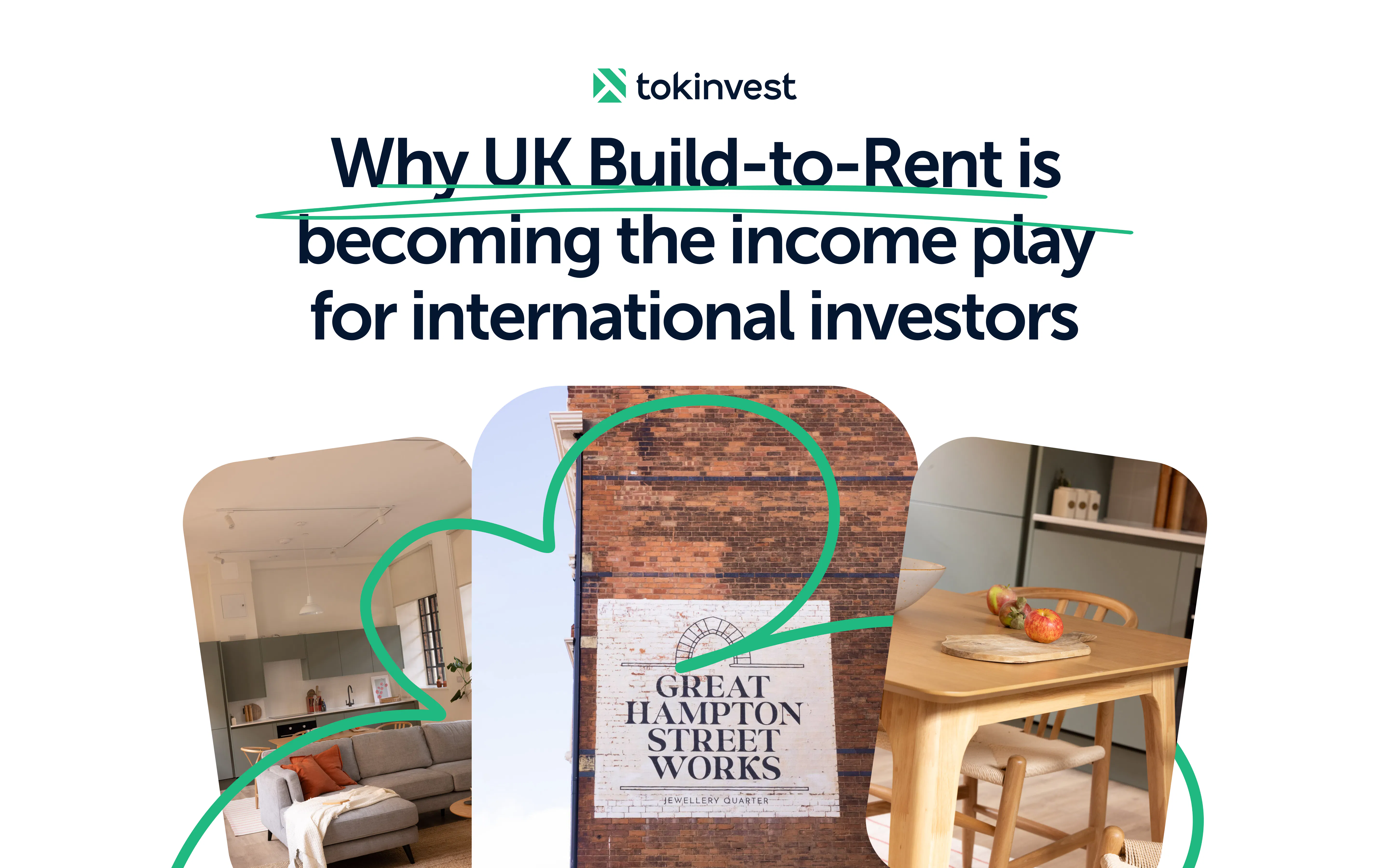
Birmingham tells a different story. City-wide gross yields are widely reported in the mid-5% to high-6% range, and in sought-after central postcodes, including the Jewellery Quarter, where heritage conversions sit alongside new residential schemes, gross yields of 6.4–6.9% are being achieved. Roughly double London's, on an asset that costs less than half as much to begin with.
That gap isn't a temporary anomaly. Around 46% of Birmingham residents rent, well above the national average, and the city's housing supply has consistently failed to keep pace with demand. One widely cited estimate puts the shortfall at over 127,000 homes needed by 2040. Undersupply, sustained demand: the conditions that tend to keep rents and yields firm.
Money is following the fundamentals
Yield is only half the case. The other half is what's being built around it.
Birmingham is currently the focus of one of the largest regeneration efforts outside London. The Birmingham East Mayoral Development Corporation, the UK's largest mayoral development corporation, has been established to coordinate more than £11 billion of investment across the city's eastern corridor, with ambitions to deliver tens of thousands of new homes and jobs. Separately, the Central Heart prospectus, unveiled to global investors, sets out plans for over 5,000 homes and a new commercial district around the HS2 Curzon Street station, backed by the council and private partners.
Layer onto that a steady run of corporate relocations, HSBC, Goldman Sachs, PwC, and Deutsche Bank have all moved significant operations into the city in recent years, and a tenant base that increasingly looks like a smaller, more affordable version of London's, minus London's price tag.
What about HS2?
Any Birmingham investment case eventually runs into HS2, and it deserves an honest answer rather than a glossy one.
The headline numbers have moved: the government's 2026 ‘reset’ pushed the project's cost toward £100 billion and the opening of the London–Birmingham passenger service out to the late 2030s. Anyone pitching HS2 as an imminent catalyst is overstating the case.
What's true, though, is that the physical construction bearing directly on Birmingham is substantially advanced, deep-bore tunnelling between London and Birmingham was completed in late 2025, and the foundations for the new Curzon Street station in the city centre were finished in early 2026. More importantly for the investment case, the regeneration and inward investment HS2 was always meant to catalyse, the Central Heart prospectus, the Eastside development, and the corporate relocations are already happening, years ahead of the first train. Birmingham doesn't need HS2 to arrive to justify the case; it needs the city to keep doing what it's already doing, with HS2 as a long-term tailwind rather than the main event.
Why this matters for international investors
For investors based outside the UK, the appeal of UK residential property has always been straightforward: a stable, transparent legal system, a chronic and structural housing shortage, and an asset class that tends to hold its value through cycles. The traditional sticking point has been where, within the UK, that exposure actually pays.
London answers the ‘stable’ question well and the ‘pays’ question poorly. Birmingham increasingly answers both, a major, internationally connected city with the legal and regulatory familiarity investors expect from the UK, but with income fundamentals that the capital simply can't match at current prices.
It's not yet a fashionable answer. That, if anything, is the opportunity: the regeneration spend, the corporate relocations and the population growth are already locked in. Wider investor recognition tends to follow, usually after the early entry point has passed.
Birmingham isn't a speculative punt on a city that might arrive. It's a city that's already arriving, still priced as though it hasn't.
To learn more about Birmingham Built-to-Rent, click here.
Disclaimer
This communication is for educational and informational purposes only and does not constitute financial, investment, legal, or tax advice. This is not an offer of solicitation. Investors should conduct their own due diligence and consult with a qualified professional advisor before making investment decisions with regard to virtual assets, as regulatory environments vary by jurisdiction. Past performance is not indicative of future results, and tokenised virtual assets carry inherent risks, including, but not limited to, market volatility and liquidity constraints. Tokinvest is not responsible for any decisions made based on this information.
You may also like
Why UK Build-to-Rent Is Becoming the Income Play for International Investors

Tokinvest Launches the World’s First Regulated “Build-to-Rent” Property RWA, Issued on BNB Chain

Dubai Emerges as Global Hub for On-Chain Real Estate Capital Formation with Tokinvest Launch

What Does the UAE Mean to You?